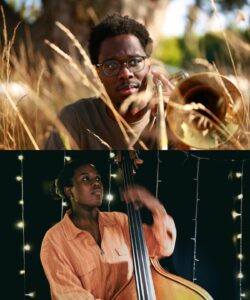
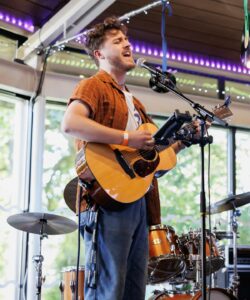
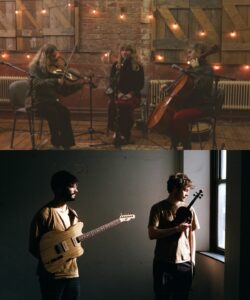
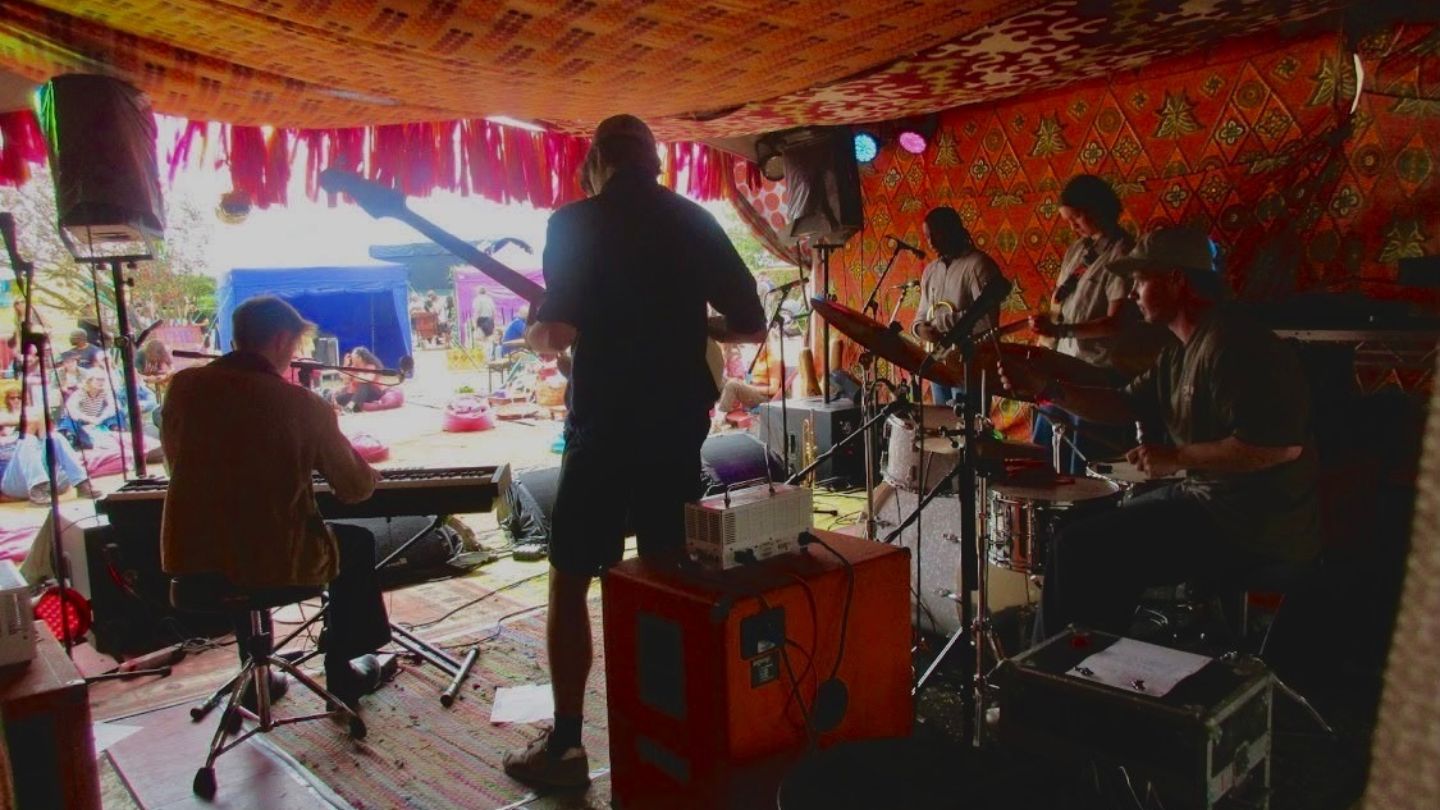
A band of young people in a festival tent playing various instruments

Experience The Vibe Lounge this autumn

The Vibe Lounge returns this season, bringing live music and new talent to the Turner Sims Foyer.

October 29, 2026

The Vibe Lounge is a series of free, 40-minute sets presented in the foyer of Turner Sims. This season, both our Vibe Lounges provide the perfect start to an evening of live music before our new Platform concerts, showcasing the next generation of talent. 
A

The first Platform performance takes place this Friday 30 October, with a double bill of jazz artists Genevieve Namazzi & Christ-Stéphane Boizi.

Catch The Vibe Lounge before the concert begins with Marsupial. The Southampton based jazz band perform their own arrangements of contemporary and Hard bop jazz tunes! They have played venues such as The Stage Door, The Concorde club and the People’s lounge at the  Victorious festival 2026. With Mia Hart on guitar, Nat Flowers on bass, James Tye on keys and Peter Richards on drums, they bring an exciting atmosphere to every venue, with their captivating musicality and invigorating improvisation.
A

Thursday 26 November sees the Folk Platform, featuring Swedish/English trio Once a Fig and trailblazing duo Spafford Campbell.

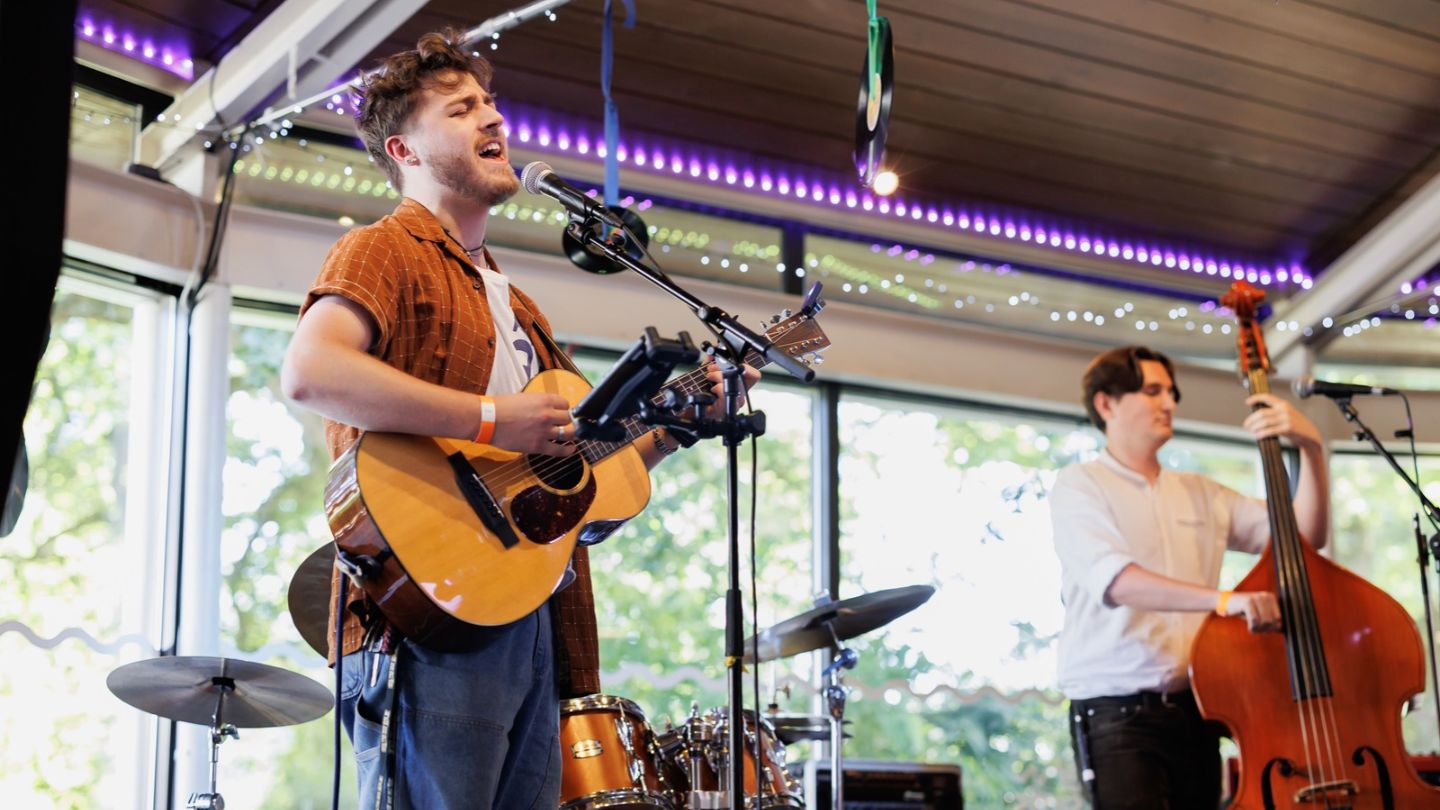
Before the concert begins, audiences can enjoy Greyhound’s Leap in the foyer. The Southampton based duo feature Luke Russ on guitar and Sunny Angel on double bass. They create and blend a mix of skiffle, folk, and bluegrass, drawing inspiration from their childhood in the Purbeck Hills. Focusing on vocal harmony and intricate guitar melodies, they utilise the hum of double bass to recount folk tales from Purbeck’s unique landscape, and bring to life their own experiences with zeal and passion for their art.

The Vibe Lounge is brought to you by The Vibe Collective, to offer an informal, and accessible introduction to the world of live music, highlighting emerging talent and giving visitors another reason to make a night of their visit to Turner Sims.

The Vibe Collective is a group of young creatives from Southampton aged 18-25. The Vibe Lounge is part of The Vibe’s exciting portfolio of youth-focused initiatives, working with young people and celebrating Southampton’s dynamic music scene.

Both Vibe Lounge events are free of charge, but tickets are required.

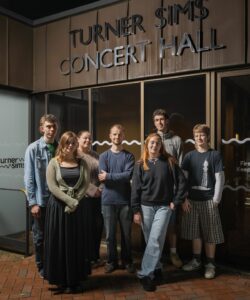
7 young people stood outside at night-time in front of a sing that reads 'Turner Sims Concert Hall'

Introducing The Vibe Collective 2026

Our new recruit, Amelia, introduces our new Vibe Collective...

October 26, 2026

My name is Amelia, and I’m so excited to be part of this year’s Vibe Collective at Turner Sims! The Vibe Collective is a group of young creatives from Southampton aged 18-25. We have been recruited by Turner Sims to work alongside their Heads of Programming and learn on the job about programming and producing live music events. Even better, it’s a paid role! As the Vibe Collective, we are here to bring fresh ideas, new perspectives, and exciting experiences to Turner Sims.

To help you get to know the people behind the group a little better, I caught up with some of the members to find out why they decided to join the Vibe Collective. Here’s what they had to say…

Below from left to right: Pietra, Daniel, Jacob, Amelia, Sasha, Cora, Joe Photography: © Nosa Malcolm
7

Amelia

I joined the Vibe Collective as I wanted to broaden my horizons from poetry and writing out into the music scene. I have always been a fan of classical and jazz music, having played instruments all my life, and this opportunity felt like a great space to connect with other young people and to learn about music, producing and Turner Sims as an organisation.


Sasha

I joined the Vibe Collective to gain experience in all stages of event organisation, from behind-the-scenes festival work to outreach and community engagement. Inspired by how my master’s work connects performers, audiences and people seeking new experiences, I want to help create events that go beyond *Vibe* itself and explore narrative and participatory engagement practices. I hope the Vibe Collective will continue to bring people together through inclusive, meaningful events that encourage participation and strengthen community connections.


Jacob

I joined the Vibe Collective to learn new skills and share my love of arts. I hope we can uplift and connect people with the events we put on.


Pietra

I joined the Vibe because it is really a vibe! As well as gaining insights into how events are programmed and marketed and putting these ideas into practice, we get to work with fantastic people too. I’m hoping to learn as much as I can about managing music venues and knowing about all the steps taken to go from the idea to the event.


Daniel

I joined the Vibe Collective because I am passionate about music and event organisation. I have had experience putting on my own DJ-based events, but I love all kinds of music and want to understand how to put on a good show, not just in a club, but also a concert hall setting. I look forward to working with like-minded people who want to make people moved and joyous by live music!

Upcoming Vibe Lounges

A

We have two exciting Vibe Lounges this autumn. Marsupial head up our first Jazz Platform on Friday 30 November, and Greyhound’s Leap join us on Thursday 26 November for a night of brilliant folk.

Book Marsupial / Jazz Platform

Book Greyhound’s Leap / Folk Platform

The Vibe Collective is supported by University of Southampton via Higher Education Innovation Funding (HEIF) from Research England.

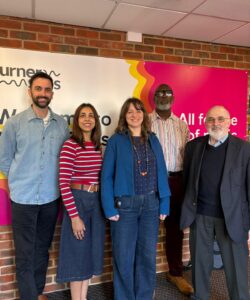
Five people stand in front of a pink and white sign, all smiling.

Turner Sims welcomes five new Strategic Board members

Turner Sims has appointed five new members to its Strategic Board, bringing additional expertise in arts leadership, audience development, communications, business and governance.

October 19, 2026

Turner Sims has appointed five new members to its Strategic Board, bringing additional expertise in arts leadership, audience development, communications, business and governance. 

Andy Cato, Bav Dhanda, Mark Bamping, Sara Lock and Dr Tony Stoller CBE join the Board as Turner Sims looks ahead to its next phase of artistic, educational and civic development. 

Together, the new members bring experience spanning strategic communications, partnership working, commercial growth, cultural leadership and governance. Their appointment broadens the skills and perspectives represented on the Strategic Board and will support Turner Sims’ ambitions as a leading music organisation, exempt charity and civic partner. 


F

Welcome to our five new board members

Nick Thorne, Co-Chair of the Strategic Board, said: “These appointments come at an important moment for Turner Sims. We are pleased to welcome five highly accomplished individuals whose experience spans arts leadership, audience development, communications, business and governance. Their insight, expertise and networks will strengthen the Board as we support Turner Sims in delivering its artistic ambitions, deepening its public impact and building a sustainable future.” 

Andy Cato is an aerospace professional specialising in project management, business development and research and technology. A lifelong arts enthusiast, he volunteers with SoundCellar Poole and brings commercial expertise, community experience and a passion for modern British jazz. 

Bav Dhanda has 22 years’ experience in marketing and brings strategic insight, creativity and a strong understanding of audiences and communities. Passionate about Southampton, she is a committed advocate for the transformative power of live music and performance. 

Mark Bamping is Director of Marketing & Communications at the City of Birmingham Symphony Orchestra, where he also leads corporate partnerships. He previously worked at the London Symphony Orchestra and Aurora Orchestra, and is a music graduate of the University of Southampton. 

Sara Lock is the Director of Audiences at Wiltshire Creative, where she leads marketing and audience development strategies. Sara was formerly Head of Arts Marketing Communications at University of Southampton, Turner Sims. She brings 20 years of experience marketing southwest venues and is passionate about the power of communications to include people.

Dr Tony Stoller CBE is Chair of the Winchester Chamber Music Festival and a former Chair of Orchestras Live. A Visiting Professor at Bournemouth University and former broadcasting regulator, he is the author of Classical Music in the United Kingdom, 1945 to 1995. 

Louise Coysh, Director of Turner Sims, said: “We are delighted to welcome Andy, Bav, Mark, Sara and Tony to the Strategic Board. Each brings exceptional expertise and a shared belief in the power of music to enrich lives and strengthen communities. Their insight and experience will be invaluable as we grow our impact, build new partnerships and shape the future of Turner Sims. I look forward to working with them to ensure Turner Sims remains an ambitious, inclusive and thriving cultural organisation for Southampton and the wider region.”

The appointments mark an important step in Turner Sims’ development, bringing fresh perspectives and extensive experience to its leadership as it continues to build an inclusive world through the joy of music. 

S

The new Turner Sims Board members with Co-Chairs Nick Thorne and Sue Littlemore

Turner Sims is part of the University of Southampton (an exempt charity) and a National Portfolio Organisation funded by Arts Council England.

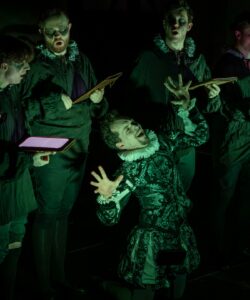
A group of male players wearing Renaissance dress performing on a dark stage

Discover the gruesome life and chilling music of Gesualdo

One of only three UK performances, Tuesday 20 October sees striking staged production 'Death of Gesualdo' bring together the spine-tingling music of revered Renaissance prince and composer Carlo Gesualdo and the tale of his gruesome life.

September 29, 2026

Celebrated early music group, The Gesualdo Six are joined by six actors and a life-like puppet to transport audiences into the hallowed world of the Renaissance court and the psychosis which afflicted this musical genius.  

A stunning series of ‘tableaux vivants’ (living pictures), filled with iconography taken directly from Renaissance painting, superimpose Gesualdo’s psyche onto his most chilling music. 


A

About Carlo Gesualdo (1566-1613), Prince of Venosa

The Guardian feature by Bill Barclay

Carlo Gesualdo wrote some of the most darkly sublime music of the late Renaissance. He also savagely murdered his wife and her lover in their bed. Now be honest: which would you like to discuss first? 

The art will always be secondary to the atrocity, however magnificent the madrigals and sacred music. Gesualdo, Prince of Venosa, had been cuckolded by the Duke of Andria in a long-running tryst that had become the scuttlebutt at court. The premeditated double murder of 1590 was a truly grisly affair, concluding in the public display of their mutilated bodies on the steps of the palazzo for several days. 

Gesualdo’s biography is often reduced to this act, yet his own end, too, was harrowing. Twenty years on, the prince had retreated to his estate to indulge in a life of ritualistic agony, reportedly employing servants to beat him thrice daily to ease sleep and constipation. This domestic nightmare included the presence of two concubines accused by his second wife of witchcraft against him. Their ghoulish testimonies, elicited under torture, suggest a household that had descended into a gothic psychosis.’ 

Gesualdo’s reputation as a composer centres on his haunting madrigals – not for him the sunlit, pastoral ones of Thomas Morely. His six books of secular madrigals, and the powerful end of life sacred work ‘Tenebrae Responsoria’, are captivating, revealing dissonance and jarring harmonies that pushed the polyphony to its emotional extremes. Characteristics which saw his revival in the 20th century when figures like Igor Stravinsky became enamoured with his sound world.

“Barclay has assembled a fantastic team for this production and it shows…Owain Park…coaxes the singers to extract every atom of anguish and exquisite melancholy from the composer’s work…another fantastically thought-provoking experiment from the Gesualdo Six, that will no doubt expand audiences for their namesake’s shocking, otherworldly vision. A dark treat for sombre times.” – Rachel Halliburton, The Arts Desk, 19 January 2026

A

About Bill Barclay 

Director, writer, and composer Bill Barclay has created dozens of theatrical concerts with the world’s most prominent ensembles. He is Artistic Director of Concert Theatre Works and was Director of Music at Shakespeare’s Globe (from 2012-2019). 

Major tours include ‘The Chevalier‘ (London Philharmonic Orchestra, Cleveland Orchestra, Chicago Symphony Center, Tanglewood, Chautauqua, Music of the Baroque, Harlem Chamber Players, Caramoor, Snape Maltings, Buffalo, Virginia, Indianapolis); ‘Secret Byrd‘ for The Gesualdo Six and Fretwork (30+ cities on tour); Anthony & Cleopatra (LA Philharmonic, BBC Symphony Orchestra, Virginia Symphony); ‘Peer Gynt‘ (Boston, Cincinnati, St. Louis and Milwaukee Symphony Orchestras); and ‘Markus Passion‘ for Oregon Bach Festival, Dunedin Consort & The Sebastians (NYC, Pittsburgh, Edinburgh, Aldeburgh, Portland, Seattle, Eugene, Chicago).  He has been commissioned five times by The Boston Symphony Orchestra, appearing across nine seasons. 

Other projects include directing the Silkroad Ensemble on tour, ‘Beyond Beethoven 9’ for Marin Alsop, Romeo & Juliet and ‘A Midsummer Night’s Dream’ for Andris Nelsons, ‘L’Histoire du Soldat’ for Charles Dutoit, ‘Four Seasons Reimagined’ for Max Richter and puppeteers Gyre & Gimble, and ‘1791: Mozart’s Last Year’ for Gianandrea Noseda and The National Symphony Orchestra. 

As a composer, Barclay composed the historic ‘Hamlet Globe-to-Globe ‘which toured to 189 countries, and ‘Call of the Wild’ that performed in 42 US states. He has composed three times for the British Royal Family, for President Obama, for the Olympic Torch, at the United Nations, and in refugee camps in Jordan and Calais. 

His newest work ‘Letters to a Young Poet’ premiered with The Brodsky Quartet at The Aldeburgh Festival before performances at Lincoln Center and Tanglewood. He regularly appears in major international festivals in Kilkenny, Spoleto, Lammermuir, Edinburgh, Death of Classical, Chelsea, Oxford, Bath, Teatro a Mil, Perth, Canterbury, Aldebugh, and many others. 

About Gesualdo Six 

The Gesualdo Six is an award-winning British vocal ensemble directed by Owain Park. Through imaginative programming, exceptional musicianship and a spirit of curiosity, the group has established itself as one of the world’s foremost vocal ensembles, performing more than 100 concerts each year across Europe, the Americas, Asia and Australasia. 

“Ingeniously programmed and impeccably delivered, with that undefinable excitement that comes from a group of musicians working absolutely as one.”
Gramophone (2020)
A

Recent highlights include appearances at Canterbury Cathedral, the Edinburgh International Festival, AMUZ, Rheinvokal and Festival de Rocamadour, as well as Tokyo’s Bunka Kaikan, New York’s Miller Theatre and the Sydney Opera House. Following its BBC Proms debut in 2023, the group returns to the Royal Albert Hall in the 2026 season and holds a five-year residency as Wigmore Hall Associate Artists. 

Collaboration is central to The Gesualdo Six’s artistic identity. Alongside performances with Fretwork, Chelys Consort and the Brodsky Quartet, the ensemble tours two acclaimed concert-theatre productions created with Concert Theatre Works and director Bill Barclay: Secret Byrd and Death of Gesualdo. 

Book your ticket for Death of Gesualdo on Tuesday 20 October here.

A black and white image of a black man wearing a suit conducting music

Celebrating a jazz legend and a pioneering thinker

100 years since his birth, Tomorrow’s Warriors’ Nu Civilisation Orchestra honour the music of Miles Davis who soundtracked the acclaimed documentary ‘The Stuart Hall Project’

September 22, 2026

Saturday 3 October features jazz stars, pianist Peter Edwards and Joti on trumpet, alongside a five-piece NU Civilisation Orchestra ensemble. Together, they present artist and writer John Akomfrah’s film ‘The Stuart Hall Project’ with Miles Davis’ soundtrack performed live.

Ahead of this powerful fusion of film, live music and cultural history, we take a deep dive to find out more.

“When I ask people where they’re from, I expect to be told an extremely long story.”
Stuart Hall
A

About ‘The Stuart Hall Project’

Stuart Hall (1932 – 2014) was a Jamaican-British academic, writer and cultural studies pioneer. He emigrated from Jamaica to the UK in 1951 to take up a place at Oxford University and became a founding figure of cultural studies with a resounding and ongoing influence on British intellectual life.

John Akomfrah’s acclaimed 2013 documentary, composed of film, music and photographs from the archives,  is a fascinating portrait of the life and times of Stuart Hall. Layered with archival footage and Hall’s own reflections, the film explores identity, race, and belonging in a changing world.  

His lifelong exploration of identity finds a powerful counterpart in the shifting musical eras of Miles Davis, performed live to illuminate each chapter of Hall’s journey.  

More than an accompaniment, the Nu Civilisation Orchestra (NCO) ’s performance becomes an integral part of the experience – deepening the film’s resonance and creating a vivid dialogue between music, ideas, and cultural change.

Watch the trailer for Nu Civilisation Orchestra: The Stuart Hall Project:
A
Hear director John Akomfrah discuss his film:
A
“Miles Davis put his finger on my soul, and it never went away”
Stuart Hall

About Miles Davis’s music

Miles Davis was Stuart Hall’s favourite musician, famously describing Davis’s music on Desert Island Discs as representing “the sound of what cannot be”. Director John Akomfrah used Davis’s shifting musical styles over the decades to track the political and cultural changes that Hall lived through. The music acts as an emotional and sonic map of the 20th century, mirroring Hall’s own complex ideas on race, identity, and the diaspora. As the music evolves from the cool jazz of the late 1950s into the avant-garde and electric fusion of the late 1960s and 1970s, it mirrors the shifting political landscapes, global upheavals, and the birth of youth counterculture.


About Tomorrow’s Warriors and the Nu Civilisation Orchestra

Brainchild of Tomorrow’s Warriors Artistic Director Dr Gary Crosby OBE, Nu Civilisation Orchestra (NCO) is a world class professional jazz orchestra. NCO was initially established in 2008 as ‘Tomorrow’s Warriors Jazz Orchestra’ to provide a platform for one of Gary’s most talented protégés – pianist/composer, Peter Edwards. The goal was to recreate Duke Ellington’s exquisite, yet rarely performed, ‘The Queen’s Suite’. The piece was met with such enthusiasm from audiences and musicians alike that Crosby felt compelled to establish the Orchestra as a permanent ensemble.

Since then, NCO has built a reputation for excellence and diversity in its members, its repertoire and its artistic collaborations; a shapeshifting ensemble that reinvents itself with every project.

Hear Gary Crosby and Peter Edwards talk about the formation of NCO:
A

NCO has performed widely across the UK, including a BBC Proms debut in 2019 and a major 2021 national tour celebrating Marvin Gaye’s ‘What’s Going On’. The Orchestra has delivered acclaimed reinterpretations of Ellington’s ‘Queen’s Suite’, Joni Mitchell’s ‘Hejira and Mingus’, Bowie’s ‘Aladdin Sane’, and Stan Getz’s ‘Focus’ with saxophonist Nubya Garcia.  

Recent highlights include collaborations with Clod Ensemble on Mingus’ ‘The Black Saint and the Sinner Lady’, joining Chaka Khan at the Southbank Centre’s Meltdown Festival, and performing with Arthur Verocai at the Barbican. 

A

Tomorrow’s Warriors and NCO have a long relationship with Turner Sims, co-producing the schools-based music education project ‘The Jazz Ticket’ in 2018 along with Southampton Music Hub. Delivered in partnership with leading venues across nine regions across England, the project culminated with a special concert featuring the Nu Civilisation Orchestra performing a new music commission from Turner Sims Southampton, supported by the PRS Foundation’s New Music Biennial. ‘A Journey with the Giants of Jazz’ by the award-winning pianist/composer, Peter Edwards, premiered at Turner Sims in 2017. 

A

About Peter Edwards 

Peter Edwards is a composer, pianist and musical director whose ‘guileless, soulful music…[is] full of emphatic chording, Latin grooves and romantic, cinematic themes’ (Guardian). He composes for stage and screen, directs the Nu Civilisation Orchestra and leads his own trio. He has worked with acclaimed artists such as Chaka Khan, Courtney Pine, Mica Paris and Zara McFarlane.

A

About Joti

A tomorrow’s Warriors alumnus, Joti is a regular soloist with Nu Civilisation Orchestra, plays and tours with Femi Kuti, Cassie Kinoshi’s Seed Ensemble, and Jean Toussaint.

Book your ticket for Nu Civilisation Orchestra: The Stuart Hall Project on Saturday 3 October here

four women on a stage, two playing violins, one opening a rainbow striped umbrella and scattering coloured confetti on the fourth woman who is laughing

Inclusive music-led performances for all: Interview with MishMash Productions

We speak with Liz Muge, Artistic and Executive Director of MishMash Productions, ahead of their visit to Turner Sims this Autumn.

September 15, 2026

On 17 October we welcome award‑winning MishMash Productions back to Turner Sims to perform ‘Fishing for Haiku’.

MishMash have become a family favourite at our venue after presenting fantastic performances for children including ‘Toot!’ and ‘Ruby’s Worry’. Known for their incredible musicians, beautiful sets and imaginative storytelling, we are so excited to welcome them back.

In this blog, we catch up with Liz Muge, Artistic and Executive Director of MishMash Productions, to find out more about the company and ‘Fishing for Haiku’.

W

How did MishMash come about and what did you hope it would be when you first dreamed up the idea? 

The idea for MishMash came about when my own children were much smaller and I was looking for shows and performances to take them to. Whilst I was blown away by the quality of the theatre and dance on offer, I could never quite find a similar live music offer. So I applied for some research funding from Arts Council England and spent some time visiting and researching theatre, dance and music for children and young audiences. At the end of that period of research, MishMash and our approach of using elements of theatre practice to present live music was born. In terms of my hopes, I suppose I’d never imagined it could blossom quite like it has, I really just hoped to provide magical experiences of live music for new audiences. I think we’ve done that!

Why is it important to you that children and young people engage with live music?

Music has always been very important to me and sitting in the middle of orchestras and ensembles was always such a special experience for me, one I wanted to try and replicate with MishMash. Giving our audiences a similar experience of connecting, up close and personal, with the music and musicians. I was also very passionate about ensuring audiences felt welcome accessing all types of music; and that’s not always the case. There are some genres of music, and Western Classical music is one of them, that a lot of people feel excluded from and feel like it’s ‘not for them’. And I really want to counter that and bring warm and welcoming experiences of live classical music that enable audiences to make their own minds up and feel welcome in those spaces.

We feel strongly that if audiences engage with the musicians and connect with them as human beings then they’re much more likely to embrace the new music we are presenting.
T

What do you think are the key ingredients to creating a performance that captures the imagination of children and young people?

For us, working with Western Classical music brings the added complexity that many of our audiences won’t be used to the sound worlds we have on offer and to counter this we want to create experiences where the audiences feel comfortable and connected to the musicians. We feel strongly that if audiences engage with the musicians and connect with them as human beings then they’re much more likely to embrace the new music we are presenting. For us memorising the music is a key part of that. And whilst it’s not common practice for Western Classical music to be memorised and this presents an additional challenge for the performers, by removing the music stands and giving the musicians the freedom to move around we can really build on that connection with audiences.

We also work closely with theatre directors and designers so that we stage and present our performances in such away that the visual presentation supports the audiences to listen and engage. Audiences often worry that they ‘won’t understand’ classical music and by presenting the music visually we are helping them to navigate around the different parts and instruments.


MishMash creates brand new performances, can you tell us about that process and the different people involved?

Our productions are all different and the process can vary. For example some of our shows, such as ‘Ruby’s Worry’ or ‘Strange Creatures’, are retellings of popular picture books where we are using the music to ‘tell’ the story. Other shows, such as ‘Fishing for Haiku’, start with the music. As musicians we get in a room together and play and listen to music and decide what really excites us and what we want to share, we then will often build a structure or a thread throughout the different pieces to create a kind of narrative to support what is in affect a ‘staged concert’. This was the approach with Fishing for Haiku. Joanna, Suzanne and Sophie (the Director) all suggested pieces of repertoire that they loved and then played around with stories to help them present the music to the audience.

The piece American Haiku by Paul Wiancko is at the centre of ‘Fishing for Haiku’ and has gifted us a wonderful structure for the piece… I won’t give any more away! We always try and bring in the right people to help us finesse our ideas and as well as our wonderful director Sophie Rivlin, we also worked with Designer Bryony McCombie-Smith and Physical Theatre specialist Tom Curzon to realise our aspirations for the piece.

As a company, what do you enjoy about coming to Turner Sims?

We love coming to Turner Sims! Jessica and the team are such champions for music and especially work for children, young people, families and schools. We share very similar values, particularly in how much we care about our audiences, which makes working together a dream. It helps that the hall is also beautiful to play in!


The next performance you are bringing to Turner Sims is ‘Fishing for Haiku’, tell us about this performance and what audience should be looking forward to.

I don’t really want to give much away but ‘Fishing for Haiku’ is such a dream of a show. It’s beautiful and clever but also extremely silly. And we think silliness is really important and sometimes much overlooked! It features such a lovely range of music from contemporary classical to folk music to improvisation to singing frogs…… and Joanna and Suzanne are amazing performers. In short it’s perfect for lovers of great music, and of poetry, friendship, make believe and play!


Book tickets for Fishing for Haiku on Saturday 17 October here.

two performers being watched by a group of children. Both performers are wearing bright colourful costumes with their arms outstretched.

Unlimited Partner Awards

Turner Sims has been announced as one of 11 organisations partnering with Unlimited to create Partner Awards for disabled artists. In this blog, Jessica Santer, Head of Programming (Engagement and Participation) explains all.

September 1, 2026

White background graphic with black text that reads: Partner Award. Disabled artists. New Work. Lasting Change.


Unlimited Partner Awards are an opportunity for arts organisations across England, Scotland and Wales to work with Unlimited to match fund a new commission for disabled artists. Each award has its own criteria and funding amount from £15,000 – £40,000. Disabled artists, or disabled led companies, across any art form can apply (with the exception of film, fashion and architecture). This year there are 11 Partner Awards, including one with Turner Sims!

Let’s hear from Jessica Santer, Turner Sims’ Head of Programming (Engagement and Participation), who is personally really excited about this opportunity for our organisation.

W

Why has Turner Sims chosen to work with Unlimited?

Unlimited is an organisation I have admired for a long time – for the work they do to change the landscape of the art that we get to see and experience in the UK, through commissioning, supporting and platforming disabled artists and advocating for sector change. When the opportunity came up to partner with Unlimited and be part of this change, I jumped at it!

It’s an incredible opportunity for Turner Sims to be part of the commissioning process alongside Unlimited, and work with a disabled artist, or disabled led-company, to create new work for audiences. It’s a chance to build relationships with new artists, and challenge ourselves to think deeply about access and inclusion in our programme. I am also looking forward to be part of a national network of arts organisations so that we can support and learn from each other.

Why now?

It’s an exciting time for Turner Sims, we are undergoing significant building works in our venue to improve disabled access, across front of house and backstage, to benefit our artists, audiences and staff. This partnership with Unlimited is part of our long-term commitment to improve access across all areas of our work – including the artists we support and present on our stage.

What kind of artist or company are you looking to work with on this commission? 

Our Partner Award is for £15,000 to develop a research and development piece for young audiences. We are looking for a disabled artist, or disabled-led company, who wants to develop a new creative piece with music at its core, but may also want to include other art forms like theatre, dance, spoken word or visual design.

We would like the piece to have the potential to be performed at Turner Sims however we are open to artists being creative about how they use the space. Our auditorium has a capacity of around 350 and a large flat stage without any wings. The artists might want to perform on stage with the audience sat in the auditorium seats, or they might want to create something small and intimate where the audience sit on stage, or take a much more site-specific approach using different spaces in the building.

We are looking for artists who want to make work for children and young people aged between 7 and 16 years old, although the piece might not cover that whole age range. The artists might choose 7-11 years or 11-16 years, for example. We want the artists to be working directly with children and young people in Southampton and/or Hampshire to be part of the creative process for this commission. Previous experience of working with children and young people is preferred, but not essential.

And ultimately, Turner Sims and Unlimited are looking for disabled artists who are ambitious, innovative and have a really strong idea!

If you are interested in applying, there is a lot of helpful information on the Unlimited website and there are some information sessions in August and September that you can sign up for.

How will Turner Sims support the artist or company that are commissioned?

As well as providing funding for the commission, Turner Sims will work closely with the artist to support them. We will have regular meetings to check in and see how things are going, we will give access to our sound technician and lighting technician to allow you to explore ideas, we will provide a workshop with our Head of Marketing and Sales to plan promotion and we will support you in making plans for workshops and engagement with children and young people in Southampton and/or Hampshire as part of a co-creation process. We know if can be really important for artists to document their process, so we will provide a professional photographer for half a day. At the end of the project, we will host an informal sharing of the research and development project at Turner Sims.

What impact do you hope the Partner Award will have?

I hope that this commission will enable a disabled artist, or disabled led company, to start developing some really remarkable work for children and young people, and that we can use our time, resources and expertise at Turner Sims to support them to do that. This commission, along with the physical changes we are making to our building through our Estates project, mark a big step change in how we support and present disabled artists at Turner Sims, I hope the partnership with Unlimited will help us to embed this into the culture of our organisation and raise our ambition for what we can achieve in the future.

If you are an artist interested in applying for any of the awards there is lots of information, including a list of FAQs, on the Unlimited website.  

Find out more

Listen to Jessica Santer talk through the her answers to our questions and learn more about the awards.
t
A Black man in a dark blue shirt holding a trumpet

Marking 21 years since Hurricane Katrina

Ahead of Byron Wallen’s ‘Hurricane Bells’ & ‘When the Levees Broke’, discover more about the artists, the music, and how their responses to the environmental disaster were created.

August 21, 2026

21 August 2026 marks 21 years since Hurricane Katrina hit south-eastern United States, with catastrophic consequences that carried major social and political impacts.

On Saturday 17 October, we commemorate this event and its aftermath through film, discussion and music. 20 years since Spike Lee released his moving four-part documentary ‘When the Levees Broke’, the evening begins with a screening of Act 1, followed by a discussion with Dr Eleonora Sammartino from the University of Southampton’s Film Studies Department. To finish, one of the UK’s most creative trumpeters and composers, Byron Wallen, brings us ‘Hurricane Bells’.

Ahead of this very special evening, we take a deep-dive into these elements and find out more about how they were created.

About Spike Lee’s ‘When the Levees Broke’ 

An incredibly powerful tropical cyclone, Katrina was one of the deadliest and costliest hurricanes in US history, killing over 1,400 people and causing $125 billion in damages. The storm caused devastating flooding in New Orleans due to levee failures, submerging approximately 80% of the city. Thousands of residents were displaced, losing their homes and all their possessions in a matter of moments.

‘When the Levees Broke: A Requiem in Four Acts’ premiered on 16 August 16, 2006. Director Spike Lee conducted nearly 100 interviews with politicians, journalists, engineers, historians, and residents to capture diverse perspectives on the disaster and its aftermath. Interspersed with news footage and stills of the hurricane and the utter carnage it left in its deadly wake, the film won numerous awards – including three Emmys – and remains one of the director’s most powerful and significant works.

For this evening’s event, we screen Act 1, followed by discussion with Dr Eleanora Sammartino from the University’s Film Studies Department.


Hero image: Byron Wallen © Urszula Tarasiewicz

A

About Dr Eleonora Sammartino 

Dr Eleonora Sammartino writes:

“The history of New Orleans has been inextricably tied to music since before the emergence of jazz and blues in the metropolis. This is a central relationship also in ‘When the Levees Broke’, in which the score composed by Lee’s long-standing collaborator, jazz musician Terence Blanchard, and the melodies rising from the city animate the images and speak of the residents’ resilience in the face of the disaster. The talk will explore this connection in Lee’s documentary and in the films and TV made in the wake of Katrina. As the city was dealing with the aftermath of the hurricane, music in these media tried to make sense of the devastation, negotiating grief and hope at once.”

Dr Eleonora Sammartino is a Teaching Fellow in the Film Studies department at the University of Southampton. Her research explores popular genres in US film and media; music in film and TV; feminisms and contemporary media culture; and stardom and the cultural politics of identity. She is particularly interested in the political value of popular culture and in the relationship between power, neoliberalism, and identity. She has published extensively on the Hollywood musical and gender representation, including articles in the European Journal of American Studies and the collections Musicals at the Margins (Bloomsbury, 2021), Working Women on Screen: Paid Labour and Fourth Wave Feminism (Palgrave Macmillan, 2024) and Border Masculinities (Palgrave Macmillan, 2024).

A

About Byron Wallen’s ‘Hurricane Bells’ 

“My piece is an exploration of the socio-political economic climate where their sound resonates.” Byron Wallen

Living at the intersection between jazz, contemporary art and politics, this extraordinary composition was created in response to contemporary artist Peter Shenai‘s work of the same name. 

Peter cast five bells using analyses of the structure of Hurricane Katrina – each one represented a 3D snapshot of the hurricane across its trajectory. Bell 1 was modelled on Katrina as it was far out in the Gulf of Mexico and Bell 5 modelled on the storm as it began to impact on land. Hung in a line and struck in order, these irregularly shaped, cyclonic bells produced a series of resonances descending in sequence, indicating the growing power of hurricane as it approached New Orleans. 

Listen to BBC Radio 4’s ‘Pursuit of Beauty’ featuring Peter Shenai talking about this project 

Gong instruments in general have this amazing political and communicative power."
Byron Wallen
A

Byron Wallen is one of the UK’s most creative trumpeters and composers. Widely recognised as a seminal figure in world jazz, he travels the world recording, teaching and performing. In 2019, London– based contemporary music outfit Filthy Lucre commissioned Byron to write music for eight8 musicians in response to Peter Shenai’s ‘Hurricane Bells’.  

Building on these unique sounds, reminiscent of Chinese bells and gongs, Wallen’s work reflects on the tragedy, taking in the culture of New Orleans and the climate crisis that threatens ever larger storms. 

A

“The reason Hurricane Katrina incurred such a huge loss of life and destruction was not because of the winds, but because of the subsequent flooding, due to insufficient levy infrastructure and the pathetic response of the US federal government.

Gong instruments in general have this amazing political and communicative power: they memorialise, they mark celebrations, they sound alarms, they call communities to gather around important issues. These bells based on the structure of Hurricane Katrina carry a powerful message and set of meanings with them. My piece is an exploration of the socio-political economic climate where their sound resonates.” Byron Wallen 

This original work for an eight8-piece band was set to premier in 2020 and was then rescheduled (due to COVID) for Shoreditch’s Rich Mix in February 2022. The iteration coming to Southampton this October is a quintet version.

Book your ticket for Byron Wallen: Hurricane Bells | When the Levees Broke on Saturday 17 October here

An Indian man in a blue tunic seated and playing the sarod

An interview with Soumik Datta

On Tuesday 3 November, renowned Bengali-born British Indian musician and composer, Soumik Datta begins his 'Melodies in Slow Motion' tour at Turner Sims. After the success of his 8-month tour of India last year, we're excited to welcome the immersive show where biological soundscapes, field recordings and new Indian music collide.

August 18, 2026

We caught up with Soumik to talk returning to tradition, discovering slow touring and The Waggle Dance of bee colonies. Learn more about his work, the skill and instruments of his band, and their recent experience of touring.

How did Melodies in Slow Motion come about and who was there with you to help bring this idea to fruition?

In 2025, I was in Mumbai on a British Council climate commission, working on the ecological crisis in a city that feels like solid concrete. And then, at a traffic light, chaos all around, horns, heat, noise, an orange butterfly landed on my shirt. In a city built to drown out anything small, this tiny creature found me, and stayed with me for the rest of the walk. It made me feel the scale of everything: how much life exists in the margins we’ve stopped noticing, the small ecosystems we’re still tied to even when we’ve forgotten them. That butterfly is where ‘Melodies in Slow Motion’ began.

The British Council commissioned the project, and we co-produced it with G5A Warehouse in Mumbai. The people who brought it to life are extraordinary: Sumesh Narayanan on mridangam, Sayee Rakshith on violin, Debjit Patitundi on tabla, and the brilliant field recordist and musician Rahul Nadkarni, who captured sounds most of us have never had the chance to hear.

F

How does the band’s specific combination of instruments fuse together to produce such an immersive experience?

The sarod sits at the heart of everything: 19 strings, with a resonance that can feel almost geological. Around it, the mridangam and tabla provide an intricate rhythmic pulse that mirrors the way the natural world operates: in patterns, in cycles, in rhythms that Indian classical percussion understands instinctively. The violin acts as a bridge between that classical framework and something more cinematic.

But what makes this band different from anything I’ve done before is the fourth layer: Rahul Nadkarni’s field recordings. He used specialist microphones to capture things you’d never normally hear: the inside of trees, under the mangroves, the dance of bees. Those recordings aren’t texture or decoration; they’re compositional. The natural world becomes another voice in the band, and through it we get to reveal some of nature’s most extraordinary secrets: the waggle dance as a language, the impossible lifespans of cicadas surviving underground for thirteen or seventeen years, the way a murmuration of birds moves as one mind. These are mysteries most audiences have never been invited inside before, and that’s exactly where this music takes them.

The natural world becomes another voice in the band, and through it we get to reveal some of nature's most extraordinary secrets..."

What was it like working with Rahul Nadkarni while curating this tour? Was integrating field recordings a new experience in your work as a musician?

Working with Rahul changed the way I think about what a musical instrument actually is. He goes to places most of us never think to listen to: underground, into ecosystems, into environments teeming with sound, and brings those sounds back with extraordinary care. He has a field recordist’s precision and a musician’s ear, and that combination is rare.

What drew me to working at this depth was a growing curiosity about the hidden languages of nature. The waggle dance: the way bees choreograph precise information for an entire colony is just one example of how much intelligence and communication exists in the world around us, completely beyond our normal perception. Rahul’s recordings open that world up. Integrating them at this level was new for me, and it fundamentally shifted how I think about composition. The natural world isn’t a backdrop to this music – it’s a co-author.

A

The performance spotlights Earth’s hidden rhythms and biological landscapes, do you have a favourite that we can look out for?

The waggle dance. Bees communicate through a remarkable figure-eight movement – scout bees return to the hive and perform a dance that tells the whole colony exactly where to find food, how far away it is, even what direction to fly. It’s a language. A choreography. When we started working on the music for it, we asked: what would that dance actually sound like inside the hive?

The rhythm is fast, almost trance-like, and the main melodic hook takes a while to emerge – deliberately, so the energy can build. When it finally arrives, it feels like an anthem. I find it genuinely moving that this hidden language has existed for millions of years, and most of us walk past it every day without knowing. You can hear Waggle Dance on all platforms now and watch us play live on Youtube.


A

You embarked on an 8-month tour of Melodies in Slow Motion in India, with a focus on intimate and meaningful spaces like schools and heritage sites. Did the band’s performance shift throughout this experience, and what will you be bringing along with you on this next leg of the tour?

Enormously. Alongside the larger concerts, I set out to explore what I’m now calling slow touring, spending real time in schools, community hubs, care centres, orphanages, and colleges, sharing the sarod in intimate settings where people could hear every detail. We’d sing together, play clapping rhythm games, just be in the music together.

This was partly inspired by the neuroscientist Daniel Levitin, who writes about music as one of humanity’s oldest tools for social bonding – something early human groups used to connect long before complex language existed. On big festival stages, there’s a distance between you and the audience. In those smaller spaces, that distance disappears entirely, and there’s a different kind of magic.

What I’m bringing to the UK is everything those eight months taught me – a show that’s been genuinely tested in the rooms that matter most. The community week across South West England, taking the music into mental health centres, and elderly care spaces like Bristol Folk House is as essential to me as the Kings Place shows. Music belongs in both places equally.


A

Listen to audience reaction after experiencing 'Melodies in Slow Motion'

What do you hope UK audiences will take away with them after experiencing Melodies in Slow Motion?

Between the four of us, we wanted to explore our roots in Indian classical music – the tradition that grounds all our training – but through the lens of the living world. We looked at rhythms in nature: fireflies synchronising their flashing, the ebb and flow of intertidal mangroves, the internal clocks that govern circadian rhythm. And this connects back to something the ancient Indian classical musicians already understood: that our mood and psychological states shift with the changing light of the day. By mapping frequencies and ragas to those changes, they weren’t just creating music – they were creating a sonic mirror for the human mind.

We’re returning to those roots. To a tradition where mind, body and environment are connected – to the natural world, and to the tiny creatures living all around us. I want people to feel that interconnection. I want them to feel the joy of standing inside a beehive, or in a field lit up with fireflies. Ultimately, I want them to feel less alone – to feel that we belong to a shared world, one that still needs looking after.


Don’t miss Soumik Datta | Melodies in Slow Motion at Turner Sims on Tuesday 3 November, 7.30pm

Book here

A packed audience on three sides watching a classical ensemble on stage under lights

Join Turner Sims’ Strategic Board — we want to hear from you

Turner Sims is looking for four new Strategic Board Members - and we want our Board to look like the communities we serve.

August 14, 2026

We’re the University of Southampton’s music venue and an Arts Council England National Portfolio Organisation. For over 50 years we’ve welcomed audiences to Highfield Campus for classical, jazz, world and folk music – and every year we reach 1,300 artists and performers, 50,000 audience members, and deliver over 140 concerts and events. Beyond the concert hall, our Engagement Programme reaches over 600 children and young people and thousands of family audiences each year. 

Now we’re looking for people from outside the University to help shape where we go next. 

Why now? 

We’re heading into an important few years: developing our next five-year business plan, delivering a major capital project to make our venue fully step-free and accessible by 2028, and taking Turner Sims on tour across the region while our building is closed for works. We need Board members who bring fresh thinking, industry expertise, and lived experience to help us get this right. 

Who we’re looking for 

We’re serious about building a Board that reflects Southampton’s communities. We’re particularly keen to hear from: 

  • People from culturally diverse backgrounds, including Black, Asian, Dual Heritage and other ethnic groups 
  • D/deaf and Disabled people 
  • Young people aged 18–35 with an interest in live music, arts and culture 
  • Anyone currently underrepresented in the arts and cultural sector 

We’re also looking for specific skills and experience, including commercial knowledge of cultural venues, artistic programming, marketing and audience insights, fundraising, and live music promotion in Southampton or the region. 

You don’t need previous board experience – we welcome first-timers as warmly as people with a track record in governance. 

What’s involved 

This is a voluntary role, but it’s not without support: we offer an honorarium for unsalaried or self-employed Board Members, and we reimburse travel expenses. The Board meets four times a year — mostly online, around 1.5 hours each — plus one in-person Away Day. Members also get complimentary tickets to Turner Sims events. 

In return, you’ll gain real experience of strategic thinking and arts leadership, grow your network, and play a genuine part in shaping Southampton’s cultural future. 

Find out more 

Not sure if it’s for you? Join one of our informal briefing sessions on Tuesday 1 September 2026 (12:00–12:45 or 18:00–18:45, via Teams) hosted by our Director and Board Co-Chair. Register by 5pm Thursday 27 August. 

To apply, send an expression of interest — a letter (max 2 pages) or a short video/audio file (max 5 minutes) — telling us why you’d like to join, what you’d bring, and a bit about yourself. Email: arts@soton.ac.uk (subject: ‘Strategic Board’) 

Deadline: midday, Wednesday 16 September 2026

Download the full recruitment pack here.  

Plain text version available here. 

To request alternative formats, please email arts@soton.ac.uk